Our Panel on Corporate VC vs. Traditional VC Got Real About Cap Tables. Here's What Founders Need to Know
Our Panel on Corporate VC vs. Traditional VC Got Real About Cap Tables. Here's What Founders Need to Know
Our Panel on Corporate VC vs. Traditional VC Got Real About Cap Tables. Here's What Founders Need to Know
News & Opinion
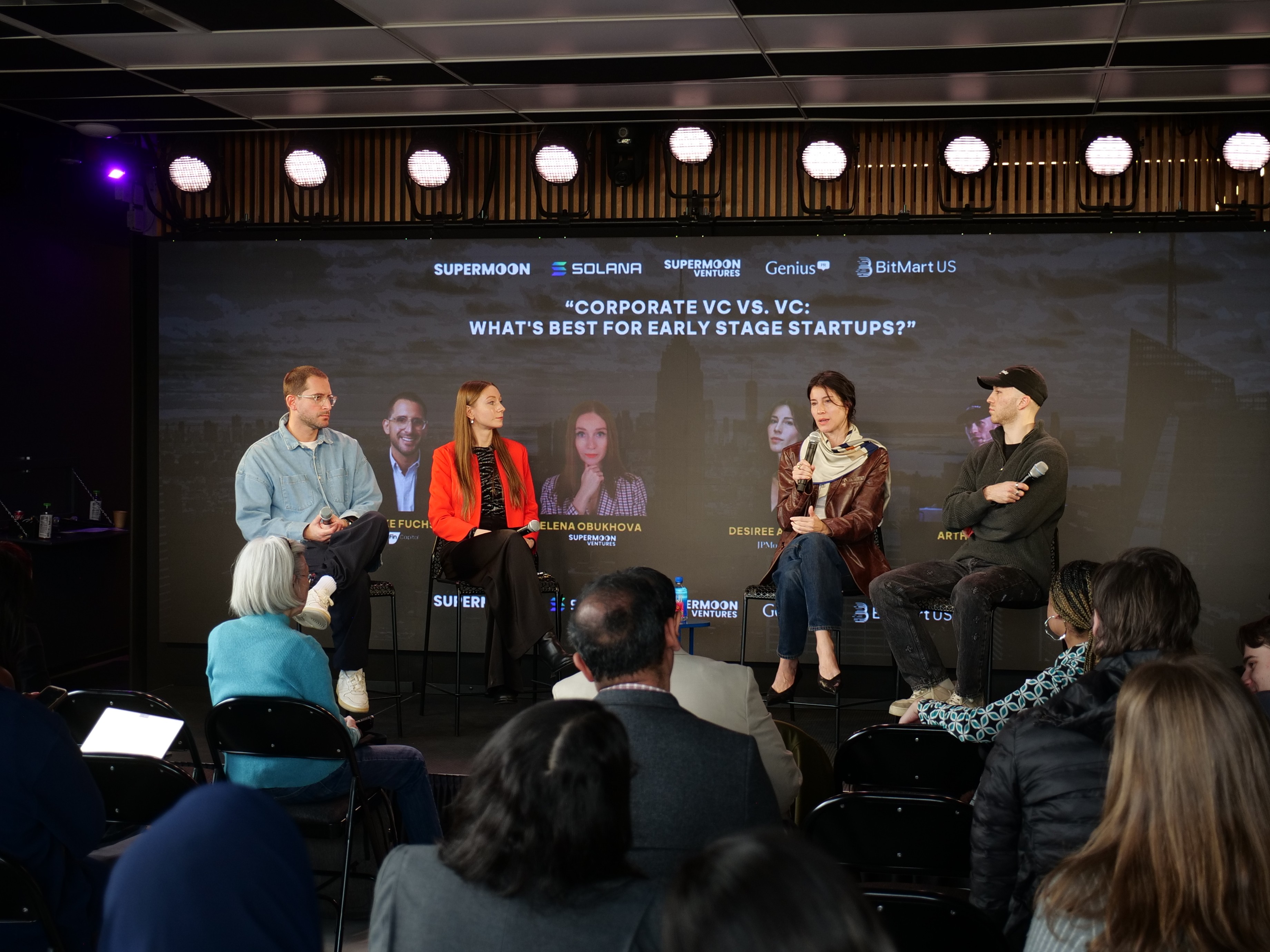
At our Startup x Capital Forum during Digital Asset Summit NY, we sat down with Jake Fuchs from Fin Capital, Elena Obukhova from Supermoon, and Desiree Almodovar from JPMorganChase, moderated by Arthur Firstov of Mercuryo, to tackle one of the questions founders ask us the most: should I raise from a corporate VC or a traditional VC?
The short answer from the panel: it's not either/or. It's a design decision.
Elena brought data that reframed the conversation early. Founders backed by CVCs actually have a higher survival rate. Those raising only from traditional investors, with no CVC on the cap table, have roughly twice the chance of going bankrupt. CVC-backed founders also see a 20 to 60% higher probability of being acquired. But she was quick to add the trade-offs: "Corporate investors move on different timelines. There are in many cases strings attached. They know their vertical, but they are very new to the traditional venture game." Her takeaway was that a CVC may not be the best lead investor on average, but having both types on the cap table is where founders benefit most.
Jake made a point we wish more founders heard before they start fundraising. "Cap table construction is actually one of the more overlooked aspects of being a founder," he said. With 4,000 venture funds in the market now, up from maybe 150 fifty years ago, optionality can become a trap. His advice: do the introspective work first. Know what you're optimizing for in each specific round before term sheets show up, not after.
The speed difference between CVCs and traditional VCs came up repeatedly. Jake has seen both sides, having worked at Banktech Ventures (backed by 110 banks) and now at Fin Capital, where the firm also runs an outsourced CVC for Sumitomo Mitsui. The contrast is clear: "In this market, things are just moving too quickly. If that's the process you need to run, you're unfortunately going to miss out on good opportunities." Desiree confirmed this from the JPMorgan side. On the VC side at Alley Corp, decisions moved fast with a couple of decision-makers. On the corporate side, "you have a lot more regulatory requirements, a lot more people."

One of our favorite exchanges was when Jake offered a hypothesis for why only about 14 to 15% of CVCs perform on par with traditional funds. Most corporate venture arms aren't structured as standalone funds, so the incentive structure is fundamentally different. Traditional VCs chase returns for their LPs. CVCs operating inside a corporation are often more focused on protecting against downside. He quoted Charlie Munger: "Show me the incentives and I'll show you the outcomes."
The conversation closed on relationship-building, and Desiree's approach stood out. She talked about getting people in the room who are just interesting, people from the art world, from Broadway, not just the usual investor circles. "Getting to know someone authentically is just fulfilling to your life, but it ends up coming back to you in a work professional capacity." She also pushed back on founders who spend too much time on persona decks and not enough time building real relationships with the people they plan to sell to.
Jake compared raising venture capital to a marriage. It's a 10-year-plus relationship, especially at the early stage, and if you don't genuinely connect with your lead investor as a person, "it's not going to work out, I could assure you."
Elena tied it together with something we tell our founders constantly: "Build relationships before you need them." But not every relationship. Find the people who are aligned on the business side and who you actually connect with as humans. The transactional approach doesn't hold up over a decade.
That last point is worth sitting with. The right investor isn't just the best term sheet. It's the person you'd want in the room when things get hard.
At our Startup x Capital Forum during Digital Asset Summit NY, we sat down with Jake Fuchs from Fin Capital, Elena Obukhova from Supermoon, and Desiree Almodovar from JPMorganChase, moderated by Arthur Firstov of Mercuryo, to tackle one of the questions founders ask us the most: should I raise from a corporate VC or a traditional VC?
The short answer from the panel: it's not either/or. It's a design decision.
Elena brought data that reframed the conversation early. Founders backed by CVCs actually have a higher survival rate. Those raising only from traditional investors, with no CVC on the cap table, have roughly twice the chance of going bankrupt. CVC-backed founders also see a 20 to 60% higher probability of being acquired. But she was quick to add the trade-offs: "Corporate investors move on different timelines. There are in many cases strings attached. They know their vertical, but they are very new to the traditional venture game." Her takeaway was that a CVC may not be the best lead investor on average, but having both types on the cap table is where founders benefit most.
Jake made a point we wish more founders heard before they start fundraising. "Cap table construction is actually one of the more overlooked aspects of being a founder," he said. With 4,000 venture funds in the market now, up from maybe 150 fifty years ago, optionality can become a trap. His advice: do the introspective work first. Know what you're optimizing for in each specific round before term sheets show up, not after.
The speed difference between CVCs and traditional VCs came up repeatedly. Jake has seen both sides, having worked at Banktech Ventures (backed by 110 banks) and now at Fin Capital, where the firm also runs an outsourced CVC for Sumitomo Mitsui. The contrast is clear: "In this market, things are just moving too quickly. If that's the process you need to run, you're unfortunately going to miss out on good opportunities." Desiree confirmed this from the JPMorgan side. On the VC side at Alley Corp, decisions moved fast with a couple of decision-makers. On the corporate side, "you have a lot more regulatory requirements, a lot more people."
One of our favorite exchanges was when Jake offered a hypothesis for why only about 14 to 15% of CVCs perform on par with traditional funds. Most corporate venture arms aren't structured as standalone funds, so the incentive structure is fundamentally different. Traditional VCs chase returns for their LPs. CVCs operating inside a corporation are often more focused on protecting against downside. He quoted Charlie Munger: "Show me the incentives and I'll show you the outcomes."
The conversation closed on relationship-building, and Desiree's approach stood out. She talked about getting people in the room who are just interesting, people from the art world, from Broadway, not just the usual investor circles. "Getting to know someone authentically is just fulfilling to your life, but it ends up coming back to you in a work professional capacity." She also pushed back on founders who spend too much time on persona decks and not enough time building real relationships with the people they plan to sell to.
Jake compared raising venture capital to a marriage. It's a 10-year-plus relationship, especially at the early stage, and if you don't genuinely connect with your lead investor as a person, "it's not going to work out, I could assure you."
Elena tied it together with something we tell our founders constantly: "Build relationships before you need them." But not every relationship. Find the people who are aligned on the business side and who you actually connect with as humans. The transactional approach doesn't hold up over a decade.
That last point is worth sitting with. The right investor isn't just the best term sheet. It's the person you'd want in the room when things get hard.
Related posts
Related posts
Related posts